
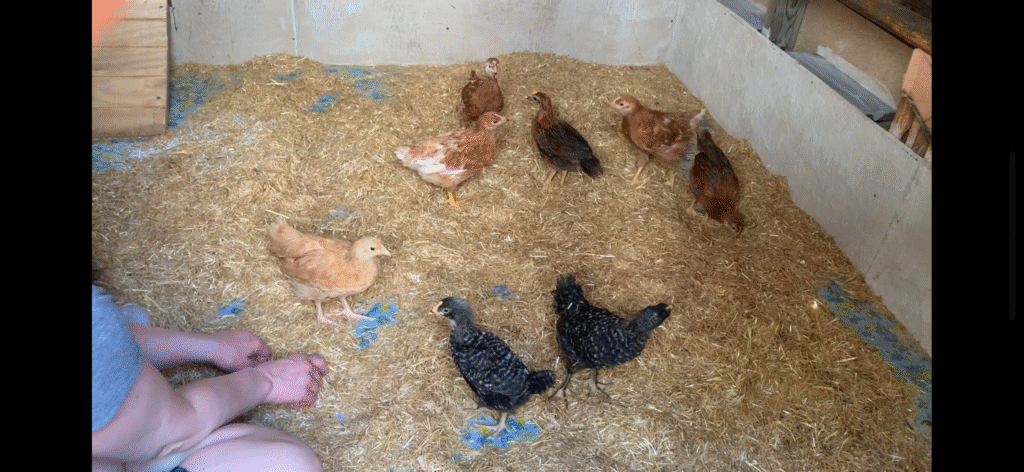
The baby chicks are fully feathered and they’re outgrowing their brooder. Now what? Moving day! It’s an exciting thought, but a stressful one too. Are they going to have enough room in their new coop? Is it predator proof? Are they going to get cold at night? All these thoughts will start to go through your mind as you decide that it’s time to move the chicks outside to their adult coop because you realize…… wow they outgrew their brooder! Now it’s time to move them outside and train them to come into their new coop.
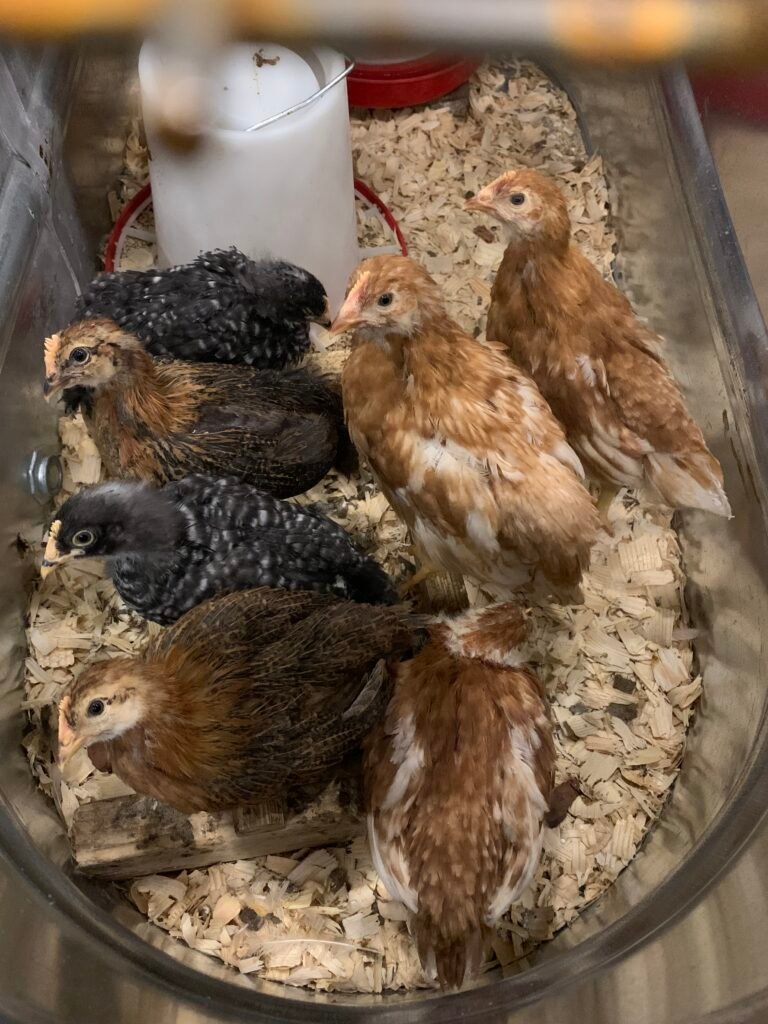
It was a bittersweet excitement for me to move our first chicks out to their new home. I was going to miss having them inside with me. I was working remotely from home, and it was so nice to turn around and cuddle a chick periodically throughout the day. I enjoyed watching them take little naps and then perk right back up again. But the other part of me was excited to see them grow into their next phase of life…. being a chicken!
These are some tips that I think will be helpful to anyone starting out with chicks and moving them out to the coop for the first time.
First
Go through every nook and cranny of the coop for one last inspection. Look for any areas that a predator can get in at. If you have openings for ventilation, cover them with quarter inch hardware cloth.
Second
Place a small light inside for them to be able to see their way around. Chickens can’t see in the dark. In fact, they can’t see when things are starting to get dark. That’s why they will seek shelter at sunset while the sun still lights the sky.
A light inside the coop will help them come inside and to resist going back outside. The light will help them see their way up to their perch bars to settle in for the night. It can be a little plug-in nightlight, or a regular lightbulb in the ceiling. It’s just for a short time and then turn it off after they are in and settled somewhere to sleep. They do need the lights off to sleep, or else they’ll stay up all night. And that’s not good for their health.
Our coop is very dark inside, even during the middle of the day, so we really need a light inside the coop. If yours has lots of light during the day, then you won’t always need to have a light inside the coop. But it does help with training the baby chicks to come in at night.
I originally had a “sunrise clock” and used the sunset feature to set a 30-minute sunset simulation. This feature starts with its light at the brightest, and then slowly dims over the course of 30 minutes until it’s off. I would just have to remember to go out there and activate it about 15 minutes before sunset. Do this for the first two weeks to get the chicks used to coming in at night.
When I had a little more money, I got a programmable Hue lightbulb made by Philips. It ramps up slowly in the morning to simulate a sunrise, and ramps down slowly at night; and it can be controlled by their app on my smartphone.
Bring the Chicks Outside
Third
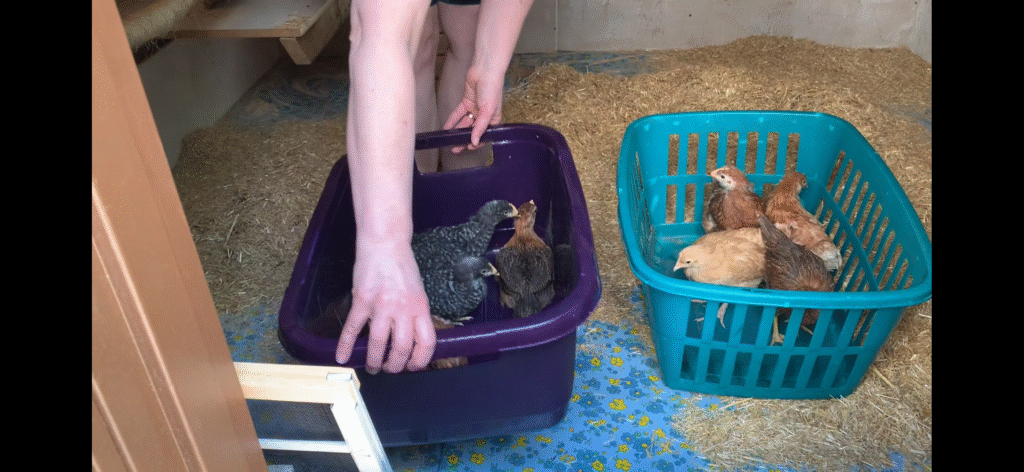
Bring the chicks out to their new coop and lock them inside the coop for the first couple of days. If they’re only around 6-7 weeks old, then they might sleep on the floor until they get the strength and courage to go up to the perch bars. Make sure the floor is cozy with ample bedding. This will help them feel more comfortable with their new environment. Keep their food and water inside the coop. The idea is to get the chicks to depend on their coop as a place to feel safe and cozy.
Fourth
Have some perch bars of different heights for the chicks to strengthen their feet on. As they grow, they’ll get better at jumping up higher. Also, give them some enriching things to do like a cabbage-tetherball and a small kiddie-pool filled with peat moss for dustbathing.
The first night I put my chicks out in the coop they did a lot of chirping. That might not always happen when you put chicks outside in their new coop, but it’s okay if it does. They’ll calm down once it’s dark. Just put them out there and leave them in there for the first day. Afterwards, make sure you spend the next week or two guiding them into their coop at night. It’s a good time to do to a headcount and make sure everyone is in. After a week or so, they start coming in on their own.
After you are certain that they reliably go out during the day and come back in at night, you can move their food and water anywhere you want to have it. I have two sets because it helps everyone find food and water when the pecking order kicks in. Those lower at the pecking order cannot enjoy food/water until the higher ones permit it. A second set of feeders helps with this. You don’t want anyone to starve.
Good luck and let me know if I can help!

Thanks for the info. I am a bit confused on the fourth point. Can you clarify what to do?
Thanks.
JR
Hi Lou! I updated the fourth point to make it easier to understand what I was trying to say. It helps to leave the group inside the coop for a day or two so that they can feel comfortable in their new environment.